
New Products: Insights from the Development Team
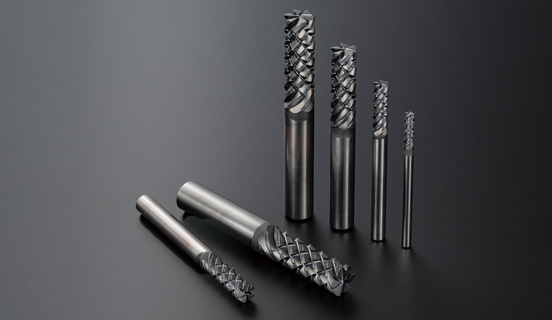
Diamond Coated Endmills for CFRP AVIX series
Developed an optimal geometry for machining aerospace parts
Enables high-efficiency machining
We wanted to solve the challenges of CFRP machining—an area with many issues
Aerospace parts require both light weight and high strength. One representative material that meets these requirements is CFRP. CFRP is a composite material made by bundling carbon fibers—finer than human hair—and solidifying them with resin. In recent years, as final product performance requirements have increased, the strength of carbon fibers has also increased. As fibers became more difficult to cut and machining became more challenging, customer demand for “machining at higher efficiency” continued to grow. However, the concern was serious: “When machining at high efficiency, the high cutting force may cause defects in expensive CFRP work material.” To address this issue as quickly as possible and develop a tool that would contribute to improving customer productivity, we launched this development project.
Developing a new geometry to reduce cutting force
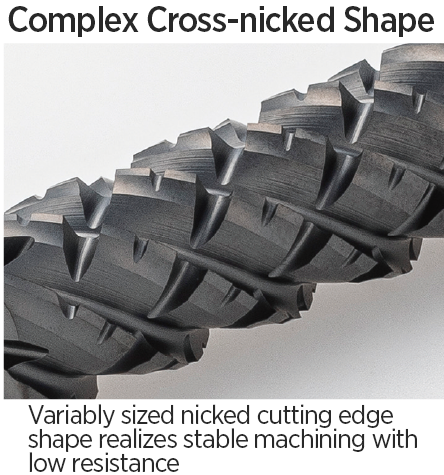
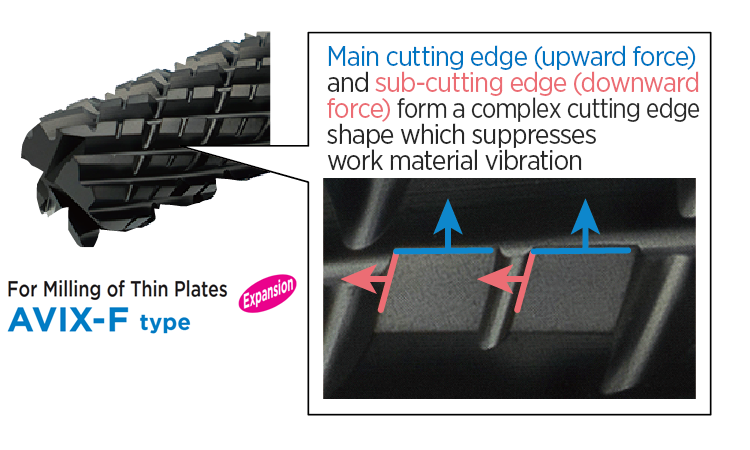
Our customers’ request was clear: “An endmill that can machine stably even if the feed rate is increased from 500 mm/min to 2,000 mm/min.” To reduce cutting force, we adopted an entirely new concept and developed the Complex Cross-nicked Shape. This geometry combines two variably sized semicircular grooves (nicks)—a Sumitomo Electric original design. With this geometry, the right-hand helix cutting edge rotates while balancing the machining forces during cutting, suppressing vibration and reducing cutting force. In addition, the smaller nicks increase the number of force application points that act to press down toward the lower left, enabling stable machining even under high-efficiency conditions.
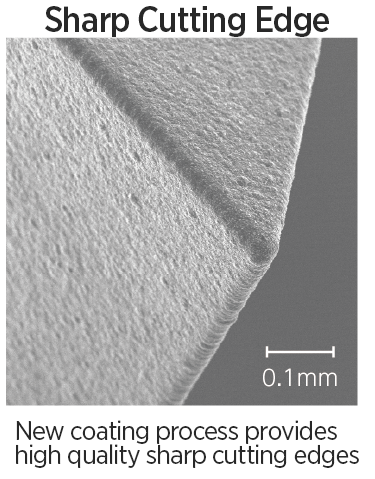
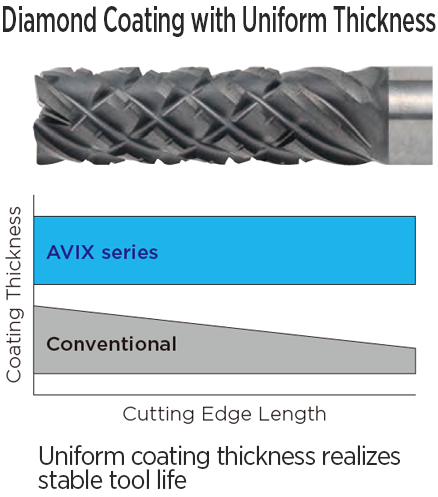
Another major theme was achieving both high quality and long tool life. Diamond coated tools have been used for CFRP machining for some time. However, a challenge remained: the coating tends to be thicker at the tool tip and thinner toward the shank, which can shorten tool life when machining at the root (lower portion) of the cutting edge length. To solve this, we developed a new technology to make the coating thickness uniform along the cutting edge length. Furthermore, by creating a sharp cutting edge, we achieved stable tool life and high-quality machining. This is how the AVIX type for high-efficiency machining was born.
Working with the mass-production plant: prototyping and quality assurance
The most important point in this development was establishing our proprietary Complex Cross-nicked Shape. Because we had no prior know-how on nicked edge geometries, development started from scratch. By leveraging analysis technology, we efficiently derived the optimal solutions for factors such as the nick geometry and helix angle, thereby shortening the development period. Also, for quality assurance of a geometry with no precedent, the perspective of the manufacturing floor was essential. Therefore, from the early stages of development we collaborated with our mass-production plant. Starting from the prototype evaluation stage, we kept mass-producibility and quality assurance in mind and built a new framework for quality assurance methods. As a result, we believe we were able to deliver a product that customers can use with confidence. In addition, for thin-plate machining applications, we pursued further vibration suppression to achieve stable machining.
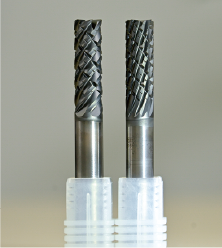
Based on the Complex Cross-nicked technology developed for the AVIX type, we worked on a multi-flute geometry and expanded the lineup with the AVIX-F type.
High-efficiency machining highly rated by customers
Customers using the AVIX type have commented, “We can machine at high efficiency now, and our productivity has increased dramatically,” giving it high praise. We also heard, “We were surprised to achieve both high quality and longer tool life,” which is extremely rewarding for the developers.
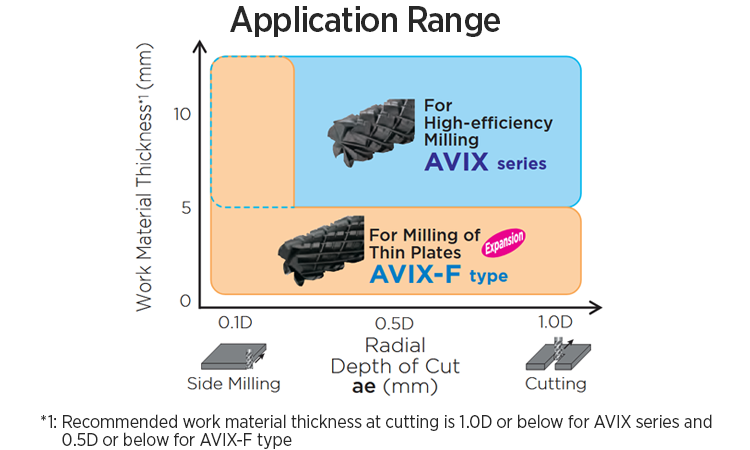
For customers machining thin CFRP plates, adoption of the AVIX-F type has been very well received, with reports of four times higher efficiency. Previously, machining required two passes—first a cutting pass and then a finishing pass—at a feed rate of 500 mm/min. Now, customers report that machining can be completed in one pass at 1,000 mm/min, which has been highly evaluated.
As CFRP is increasingly used not only in aerospace but also in automotive, semiconductor, and medical fields, we are confident this tool can contribute to many customers. We will continue expanding the lineup to respond to customer needs in detail—please look forward to what’s next.
* This article was published in 2026.
For more details on the products introduced here, please see below.