
New Products: Insights from the Development Team
Coated Carbide Grades for Small Product Turning
AC1135U
Achieving Remarkable Tool Life Extension in Machining Precision Parts, Including Stainless Steel
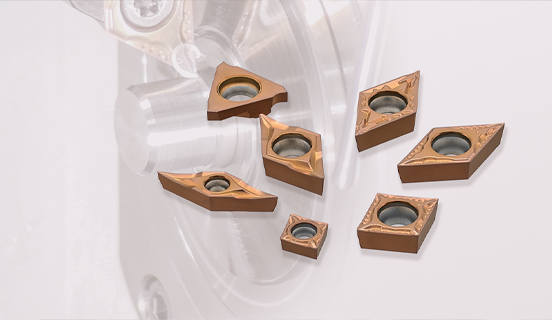
Addressing the Challenge of "Short Tool Life"
In fields such as automotive, semiconductor manufacturing equipment, and medical devices, components are becoming increasingly precise, leading to a rise in the use of stainless steel, which is known for its durability and heat resistance, as a material for precision parts. Particularly, in the machining of corrosion-resistant materials like SUS316L, customers have expressed concerns regarding the "short tool life." Acknowledging the issues of tool costs and the increased replacement frequency in the machining process, we embarked on the development of a new material grade optimized for stainless steel machining.
Developing a New Material Grade with Optimal Composition and Latest Technology
Our first focus was on developing a new coating. Stainless steel presents challenges like easy built-up edge at the cutting edge, which often leads to a poor finish. Therefore, we made "minimizing built-up edge" our primary goal. Through repeated prototyping and validation, we adopted a TiCN-based composition as the anti–built-up edge layer, enabling the reduction of built-up edge under fine cutting and low-speed conditions. Since TiCN alone is prone to cracking, we employed an ultra-fine TiAlBN-based composition for the anti-chipping layer to mitigate sudden chipping.
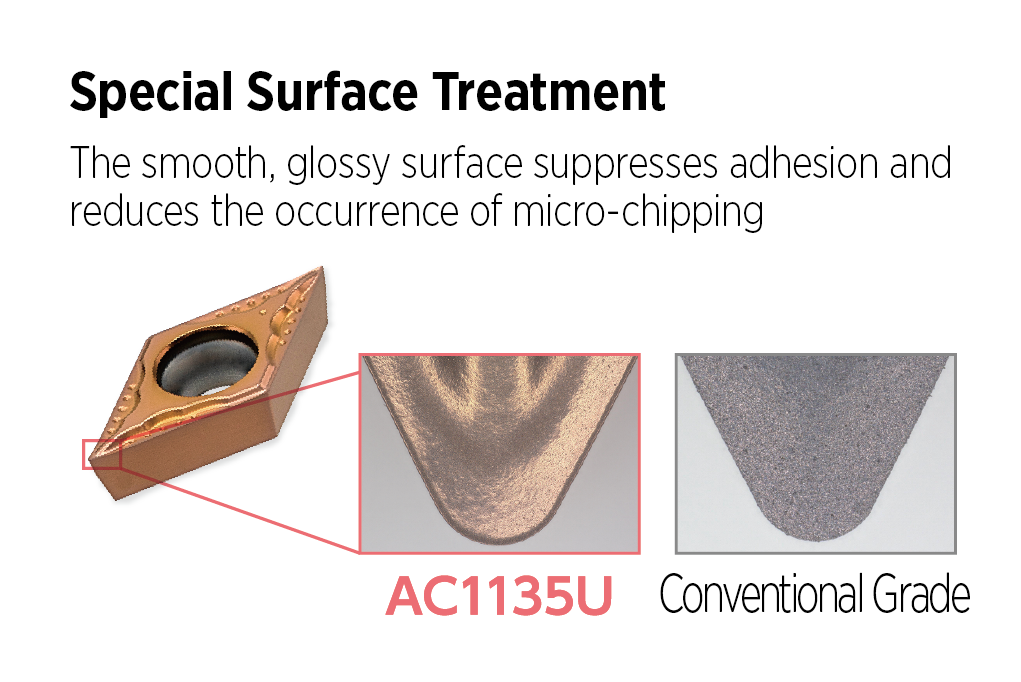
Additionally, we implemented our unique technology for special surface treatment to further suppress built-up edge. By combining these built-up edge and anti-chipping layers along with the special surface treatment, we developed a new coated grade: AC1135U that significantly contributes to reducing tool costs and the replacement frequency in small automatic lathe machining.
Moreover, we incorporated our latest technology for high-adhesion bonding to enhance the bonding strength between the base material and coating, improving stability. This resolved issues such as cutting edge built-up edge and tearing of the machined surface, maintaining the quality of the machined surface and enhancing long tool life.
Identifying Causes of Dimensional Variability and Surface Roughness Deterioration
In this development, we placed greater emphasis on evaluating surface roughness and dimensional variability, factors that customers consider when determining tool life. In addition, we pursued a new initiative to quantitatively assess the appearance quality, specifically surface gloss, which is not represented by numerical values like Ra and Rz.
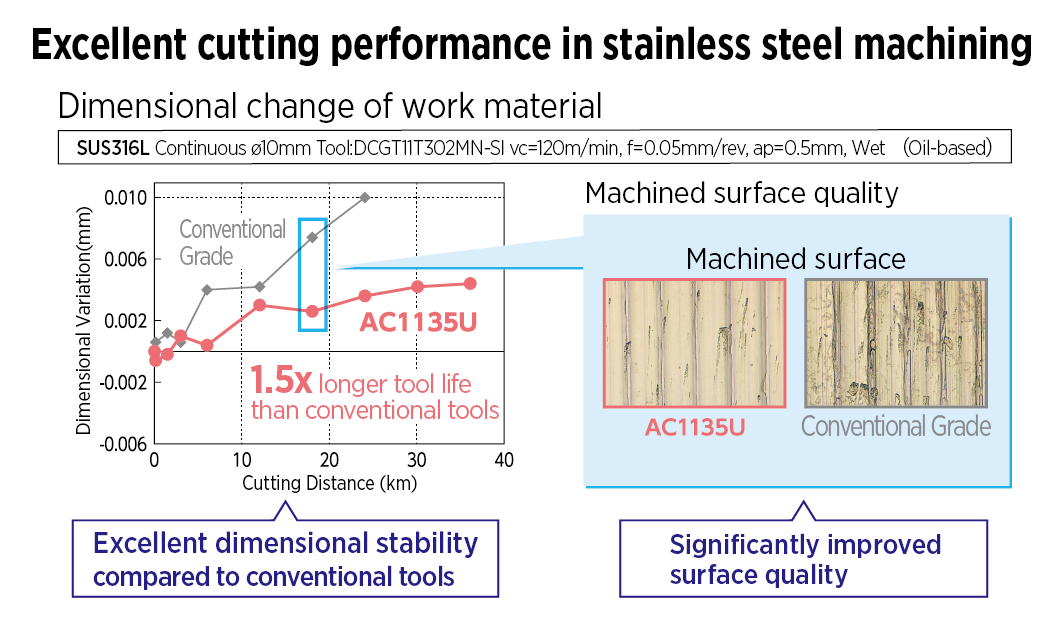
One of our greatest challenges was identifying the causes of deterioration in dimensional variability and surface roughness. Through repeated observations of cutting edge damage, we discovered that surface roughness deterioration was caused by unexpected chipping at the boundary of the front cutting edge and the cutting edge ridge, while dimensional variability was triggered by progressive tool wear. Although we evaluated high abrasion-resistant, hard coatings and heat-resistant coatings, we were unable to suppress progressive tool wear. Upon detailed observation of the cutting edge cross-section, we pinpointed that cracks within the coating caused by cutting load during machining and subsequent built-up edge removal and peeling led to chipping and wear progression. This finding established "suppression of built-up edge" as the guiding principle for our material development.
Moreover, through trial and error, we managed to develop AC1135U in a remarkably short timeframe of about one year, largely due to our customers' tremendous cooperation, including their swift testing from the prototype stage. The results have been well received, reflecting the high expectations of our customers.
Additionally, the wealth of knowledge from Sumitomo Electric played a crucial role in accelerating development; for example, we made save time in our evaluations as the utility of the built-up edge TiCN-based layer was already established through computational science.
Achieving 12.5 Times Tool Life in Semiconductor Equipment Parts Machining
Since its launch in November 2025, AC1135U has received high praise. MicroCut Co., Ltd. has reported tool life improvements ranging from approximately 3 to 5 times, with a remarkable maximum of 12.5 times. Furthermore, we have achieved more than double the tool life across various sectors, including automotive parts, beverage packaging, medical products, and electrical components. Customers commend its stable performance across various materials, including stainless steel, steel, and copper.
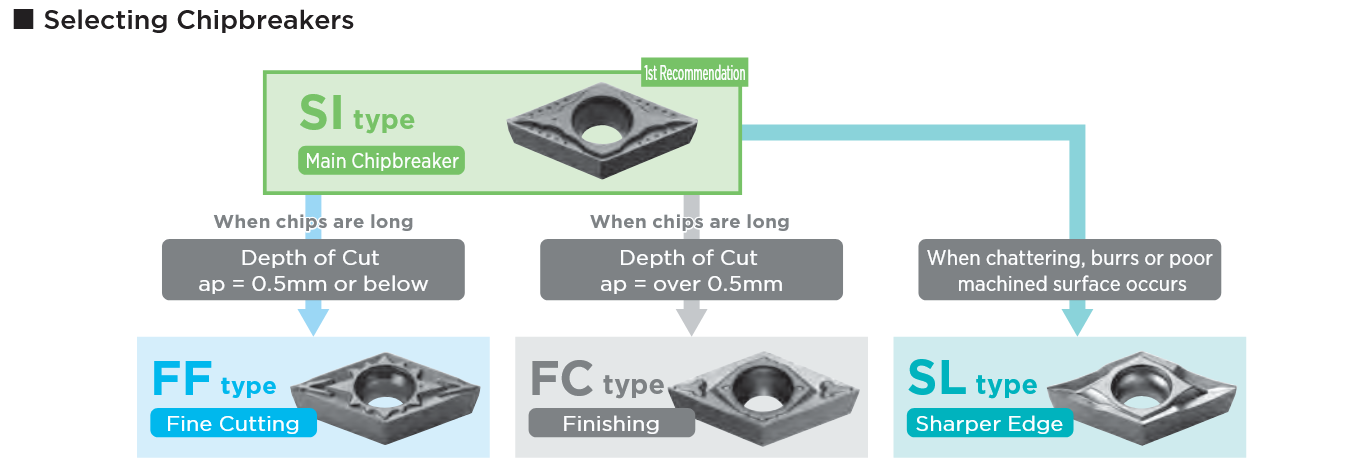
Additionally, by selecting the optimal chip breaker, customers can achieve the performance they desire. Our top recommendation is the SI type, while for those requiring sharper cutting performance, the SL type may be appropriate; thus, customers can optimize tool geometry alongside material benefits.
Looking ahead, we plan to respond to customer requests by increasing the lineup of grades and similar materials to accommodate a variety of workpieces. We invite you to look forward to our future updates.
* This article was published in 2026.
For more details on the products introduced here, please see below.